
Introduction
The global plastics industry is undergoing a historic transformation driven by environmental concerns, regulatory pressure, and sustainability goals. Conventional plastics derived from fossil fuels such as polyethylene (PE), polypropylene (PP), and polystyrene (PS) have provided immense value due to their durability, versatility, and cost efficiency. However, their persistence in the environment for hundreds of years has become a major ecological challenge.
Recent research developments in Materials Science and Polymer Science have led to the emergence of bio-based alternatives. One such breakthrough is the development of bamboo-based biodegradable plastic, reportedly capable of matching the mechanical strength of petroleum plastics while decomposing naturally within about 50 days under suitable conditions.
This innovation could represent a major shift toward sustainable materials engineering.
Why Bamboo?
Bamboo is one of the fastest-growing plants on Earth and offers several advantages as a raw material.
Key Properties
- Growth rate: Up to 1 meter per day
- Renewable resource
- High cellulose content
- Excellent fiber strength
- Carbon-negative crop
Bamboo consists mainly of:
Component | Approximate Percentage |
Cellulose | 40–50% |
Hemicellulose | 20–25% |
Lignin | 20–25% |
These components provide an excellent base for bio-polymer extraction.
Raw Material Extraction
Bamboo grows rapidly—up to 1 meter per day—without pesticides or fertilizers, sequestering 197 million tons of CO2 annually in China alone while regenerating from the same root system. Petroleum plastics rely on fossil fuel extraction, emitting high GHGs (e.g., 1.8-3 kg CO2e per kg plastic) and risking spills. Bamboo avoids deforestation and food crop competition, yielding a negative carbon footprint potential.
Production Phase
BM-plastic production uses low-energy deep eutectic solvents and ethanol, with costs at $2,302 per ton, competitive with petrochemicals (~$1,500-2,500/ton). Bamboo processing burns waste for energy, minimizing emissions; traditional plastics consume 60-100 MJ/kg in energy-intensive cracking and polymerization. Result: Bamboo products show 50-80% lower GWP than plastics like PVC or steel equivalents.
How Bamboo Plastic is Produced
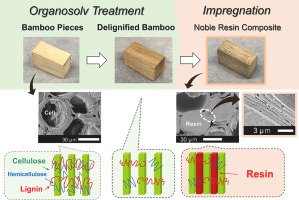
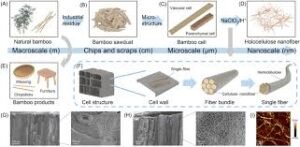
The process typically involves converting bamboo biomass into cellulose-based biopolymer material.
Step-by-Step Process
- Bamboo Harvesting : Mature bamboo stems are harvested and cleaned.
- Mechanical Crushing : The bamboo is crushed into fine fibers.
- Cellulose Extraction : Chemical or enzymatic treatment removes lignin and hemicellulose.
- Nanocellulose Formation :Cellulose is processed into nano-cellulose fibers, which are extremely strong.
5. Polymer Formation
These fibers are combined with biodegradable binders such as:
- PLA (Polylactic Acid)
- Starch polymers
- Bio-resins
6. Film or Sheet Production
The composite is then converted into:
- Films
- Sheets
- Molded parts
This results in a bio-plastic with high tensile strength.
Manufacturing Compatibility
BM-plastic uses standard injection molding and extrusion at low temperatures, requiring no new equipment—ideal for retrofitting polymer plants. PLA demands specialized drying and high-heat processing (160-180°C), limiting lines to 10-20% of total capacity and raising capex.
Use and Recycling
During use, BM-plastic withstands heat (>180°C), humidity, and stress like petroleum types but retains 90% strength after closed-loop recycling via solvent reprocessing. Petrochemicals degrade or downcycle, losing value; bioplastics like PLA often require industrial composting. This enables multiple cycles, cutting virgin material needs.
Mechanical Strength Comparison
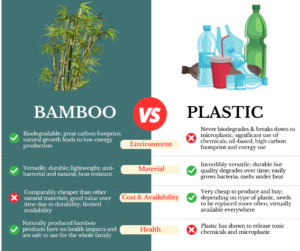
One of the most impressive claims about bamboo plastic is its strength.
Property | Bamboo Plastic | Conventional Plastic |
Tensile Strength | Comparable | High |
Flexibility | Moderate | High |
Biodegradability | Excellent | Very Poor |
Carbon Footprint | Very Low | High |
Nanocellulose fibers are sometimes stronger than steel on a weight basis, making them ideal for advanced materials.
Biodegradability Advantage
Traditional plastics degrade extremely slowly.
Material | Decomposition Time |
Plastic bags | 500–1000 years |
PET bottles | 450 years |
Bamboo plastic | ~50 days |
Under composting conditions with microbes and moisture, bamboo plastics can break down into:
- Water
- Carbon dioxide
- Organic biomass
No microplastics are left behind.
End-of-Life Disposal
Stage | Bamboo Plastic (BM) | Traditional Petroleum Plastic |
Biodegradation | Complete in soil (50 days, microbes) | Centuries; microplastics persist |
Carbon Footprint | Negative (sequestration + waste energy) | Positive (2-4 kg CO2e/kg) |
Pollution | No toxins; nutrient return to soil | Leaches chemicals, ocean harm |
BM-plastic’s rapid soil breakdown outperforms PLA/PBAT (partial degradation) and eliminates incineration/landfill burdens.
Overall Lifecycle Comparison
Bamboo materials like BM-plastic achieve 70-90% lower environmental impacts (GWP, acidification) than plastics per LCA reviews, driven by growth sequestration outweighing processing emissions. Techno-economic studies confirm scalability without ecological trade-offs, ideal for India’s bamboo-rich regions in replacing additives and packaging. Full adoption could slash plastic pollution while supporting carbon neutrality goals.
Environmental Benefits
- Reduced Carbon Emissions : Bamboo absorbs large amounts of CO₂ during growth.
- Lower Pollution : Biodegradable plastics reduce landfill accumulation.
- Renewable Resource : Unlike petroleum plastics, bamboo is continuously renewable.
- Rural Economic Development : Bamboo cultivation can support farmers and agro-industries.
Bamboo’s rapid growth (up to 1 meter/day) and CO2 absorption make it ideal for reducing fossil fuel dependency, as bioplastics currently form just 0.5% of 400 million annual tonnes of plastic production. Unlike persistent petrochemicals creating microplastics, BM-plastic decomposes completely in under two months, verified by soil burial tests. It cuts landfill waste and greenhouse gases without sacrificing performance.
Countries with strong bamboo ecosystems include:
- China
- India
- Vietnam
- Thailand
- Indonesia
- Vietnam
- Brazil
- Ethiopia
- Columbia
- Myanmar
- Others ( Japan, Philippines, Ecuador, Kenya, Uganda, Nepal, etc.)
Potential Applications
Bamboo plastics can potentially be used in several sectors. High-strength bamboo molecular plastic (BM-plastic) excels in demanding applications requiring durability, heat resistance, and biodegradability, matching or exceeding petroleum plastics like HIPS, PMMA, and PA66. Its 110 MPa tensile strength, thermal stability above 180°C, and waterproofing make it ideal for replacing traditional plastics in high-stress environments.
Automotive Components
BM-plastic suits interior panels, dashboards, and under-hood parts due to injection moldability and vibration resistance—proven in lab prototypes for car manufacturers. Unlike brittle bioplastics, it withstands automotive cycles without additives. Also this can be used for Bio-composites.
Consumer Electronics
Ideal for appliance housings (e.g., washing machines, refrigerators) and device casings, leveraging chemical resistance and processability into complex shapes. Its recyclability supports multiple re-molding without strength loss.

Packaging
Application | Key Advantages | Comparison to Plastics |
Rigid Packaging | Impact-resistant bottles, trays | Stronger than PET, soil-degradable |
Construction Fittings | Pipes, profiles (humidity-proof) | Outperforms PVC in strength/weight |
Agricultural Tools | Handles, mulch films | Replaces PP; compostable post-use |
Medical Devices | Non-toxic casings, trays for sterile products | Sterilizable, no microplastic risk |
Food & FMCG | Eco friendly | Food containers, disposable cutlery, carry bags |
These leverage BM-plastic’s scalability for India’s manufacturing—auto parts, packaging additives, and reprocessing align with your consulting focus. Prototypes confirm viability for high-volume production by 2027.
Besides the above, Bamboo molecular plastic (BM-plastic) suits medical, healthcare, agriculture, and other sectors due to its 110 MPa tensile strength, >180°C thermal stability, non-toxicity, and full soil biodegradability in 50 days—outperforming PLA while matching petroleum plastics.
Medical Applications
BM-plastic enables sterilizable trays, surgical instrument casings, and orthopaedic supports via injection molding into precise shapes without brittleness. Example: Biodegradable implants, Custom prosthetic fittings that degrade safely post-use, reducing hospital waste unlike PVC, which leaches toxins.
Healthcare Uses
Ideal for non-toxic device housings (e.g., ventilator parts, diagnostic tool shells) and single-use PPE trays, leveraging chemical resistance and closed-loop recyclability. Example: Biodegradable syringe barrels or pill organizers that compost in soil, cutting microplastic risks in medical waste streams. Recently bamboo fibre based sanitary pads have been developed
Agriculture Applications
Perfect for durable mulch films, seedling trays, nursery pots and tool handles that withstand UV/humidity yet break down fully after one season, enriching soil via microbial action. Example: Injection-molded irrigation pipe fittings or greenhouse panels replacing PP, supporting crop rotation without tillage residue.
Other Applications
In construction, it forms humidity-proof profiles and fittings; automotive uses include vibration-resistant interior panels. Example: High-impact packaging trays for electronics (stronger than PET) or compostable agricultural netting, aligning with India’s bamboo resources for scalable reprocessing.
Recent development happened in China
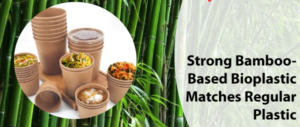
China has developed a groundbreaking bamboo-based plastic that matches petroleum plastics in strength while fully biodegrading in soil within 50 days. This innovation, highlighted in the attached image from China TechTimes, stems from recent research by Chinese scientists and offers a sustainable alternative amid global plastic pollution concerns.
Breakthrough Overview
Researchers at Northeast Forestry University and Shenyang University of Technology, led by figures like Dr. Dawei Zhao, created this “bamboo molecular plastic” (BM-plastic) from bamboo cellulose. The material achieves a tensile strength of 110 megapascals, surpassing many conventional plastics, and supports standard manufacturing like injection molding for automotive parts and appliances. Published in Nature Communications in October 2025, it addresses bioplastics’ historical weakness by reorganizing cellulose chains into a dense, durable structure.
Production Process
The process starts by treating fast-growing bamboo—yielding five times more biomass than timber—with zinc chloride and mild acid to break chemical bonds into smaller cellulose molecules. Ethanol is then added, prompting reorganization into a solid, moldable plastic that retains bamboo’s natural cellular structure for waterproofing and resilience. This non-toxic, alcohol-based solvent method enables scalability without competing with food crops.
This table highlights why the material suits high-stress uses like car interiors.
Property | Bamboo Plastic | Conventional Plastic | Notes newscientist+2 |
Tensile Strength | 110 MPa | 50-100 MPa | Exceeds many petroleum types |
Thermal Stability | High | Comparable | Suitable for appliances |
Recyclability | 90% strength retained | Varies | Closed-loop multiple cycles |
Biodegradation in Soil | 50 days | Centuries | No harmful residue |
Relevance to India
India has one of the largest bamboo resources in the world. Under the National Bamboo Mission, the government is promoting bamboo cultivation for industrial uses. This opens massive opportunities for:
- Bioplastic manufacturing
- Green packaging
- Rural industries
- Export potential
States with strong bamboo availability:
- Assam
- Tripura
- Arunachal Pradesh
- Karnataka
- Kerala
Bamboo molecular plastic (BM-plastic) costs about $2,302 per ton to produce, positioning it competitively between conventional petroleum plastics ($1,500-2,500/ton) and pricier bioplastics like PLA ($2,000-5,000/ton). This techno-economic analysis from the original research highlights its viability for scaling without premium pricing. Bamboo molecular plastic (BM-plastic) outperforms PLA in scalability due to its use of abundant, non-food bamboo feedstock and compatibility with existing plastic manufacturing infrastructure. PLA relies on corn starch, facing food crop competition and agricultural limits, while BM-plastic leverages fast-growing bamboo plantations.
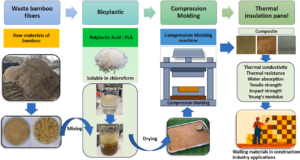
Scalability Comparison
Factor | BM-Plastic | PLA |
Feedstock Scale | Unlimited (bamboo farms) | Limited (corn/land) |
Production Capacity | Existing lines | Specialized (~10% market) |
Cost at Scale | <$2,000/ton potential | $2,000-4,000/ton |
Recycling Efficiency | 90% strength retained | Industrial composting only |
Market Readiness
BM-plastic’s solvent recovery enables continuous production with minimal waste, positioning it for 10-50x faster commercialization than PLA’s fermentation bottlenecks. For India’s bamboo-rich regions, BM-plastic aligns with recycling hubs, bypassing PLA’s import dependency and infrastructure gaps.
Feedstock Availability
Bamboo yields 5x more biomass than trees, regenerating without replanting, with China producing millions of tons annually for easy scaling. PLA’s corn-based supply chains compete with food, driving price volatility and land constraints; global PLA capacity lags at ~2.5 million tons/year versus plastics’ 400 million.
Production Cost Breakdown
Key expenses for BM-plastic include raw bamboo (37.72% of total) and solvent/ethanol recovery (23.82%), with low energy use at room temperature. Petrochemicals face volatile oil prices and high cracking energy; PLA depends on costly corn starch and fermentation. Solvent reusability in BM-plastic cuts long-term costs by 80-90%.
Material Type | Cost per Ton (US$) | Key Drivers nature |
BM-Plastic (Bamboo) | ~2,302 | Bamboo feedstock, reusable solvents |
Petroleum (HIPS, PMMA, PA66) | 1,500-2,500 | Oil prices, energy-intensive |
PLA (Corn-based) | 2,000-5,000 | Crop competition, processing |
PHA/PBAT (Other Bio) | 3,000-7,000 | Fermentation, limited scale |
BM-plastic narrows the gap with traditional options while outperforming other bioplastics economically.
Scalability Factors
China’s bamboo abundance (abundant, fast-growing) and policy support like “Bamboo as Substitute for Plastic” enable volume discounts, potentially dropping costs below $2,000/ton at scale. Recycling retains 90% value, unlike downcycling in petroleum chains; no new equipment needed for injection molding. For Indian markets, local bamboo could undercut imports, boosting ROI in additives and packaging amid rising plastic levies.
Long-Term Economics
Over lifecycle, BM-plastic saves via biodegradability (no waste management) and sequestration, yielding 20-50% lower total ownership costs than persistent plastics. Fluctuating oil prices amplify advantages; experts project competitiveness in high-value apps like auto parts by 2027. This makes it attractive for polymer reprocessing and biodegradable sectors.
Main cost drivers for BM-plastic production stem from the feedstock and solvent recovery processes detailed in the original Nature Communications research, positioning it competitively at $2,302 per ton. Bamboo feedstock dominates at 37.72% of total costs due to harvesting and transport from fast-growing plantations, though China’s vast supply mitigates price volatility. Solvent and ethanol recovery accounts for 23.82%, but high recyclability (80-90%) via distillation sharply reduces net expenses over multiple batches.
Energy costs remain low at room temperature processing versus petrochemicals’ high-heat cracking, while waste bamboo combustion offsets further expenses. For Indian scalability, local bamboo cuts feedstock to under 30%, potentially dropping total below $2,000/ton amid policy incentives.
Opportunities for the Plastic Industry
For professionals in polymer industries, bamboo plastic technology offers several strategic opportunities:
New Business Segments
- Bioplastic compounding
- Bio filler masterbatch
- Sustainable packaging materials
Machinery Adaptation
Most plastic processing machines like:
- Extruders
- Injection molding machines
- Thermoforming lines
can be modified to process bio-composites.
Challenges
Despite its promise, bamboo plastic still faces some limitations.
Cost – Bio-plastics remain more expensive than conventional plastics.
Scalability –Large-scale industrial production is still evolving.
Performance Limitations –Heat resistance and durability may require improvement.
Infrastructure –Industrial composting facilities are still limited in many regions.
Environmental impact vs traditional plastics lifecycle
Bamboo molecular plastic (BM-plastic) offers superior environmental benefits over traditional petroleum plastics across its lifecycle, from raw material extraction to end-of-life disposal. Lifecycle analyses of bamboo-derived materials consistently show lower global warming potential (GWP) and enhanced carbon sequestration compared to petrochemicals.
Future Outlook
While lab results excel, experts note scalability, cost, and real-world performance need validation before mass adoption. Recycling retains strength effectively, boosting economics, but industry hurdles like manufacturing integration remain. For India’s plastics sector—your focus area—this could inspire local bamboo sourcing for additives, recycling, and biodegradable packaging, aligning with sustainability trends in South Asia. Ongoing tests may position it as a game-changer by 2027.
The global bioplastics market is expected to grow rapidly as governments introduce regulations against single-use plastics.
Key growth drivers include:
- Environmental awareness
- Circular economy policies
- Technological breakthroughs in bio-materials
- Bamboo plastics could become a game-changing material for sustainable manufacturing.
Conclusion
The development of bamboo-based biodegradable plastics represents a significant milestone in the transition toward eco-friendly materials. By combining the strength of conventional plastics with rapid biodegradability, this innovation addresses one of the most pressing environmental issues of our time. For countries with abundant bamboo resources, particularly India, this technology offers enormous potential for green industrial growth, rural development, and sustainable manufacturing.